

Perfectopia
"In a perfect world, you are the imperfection."
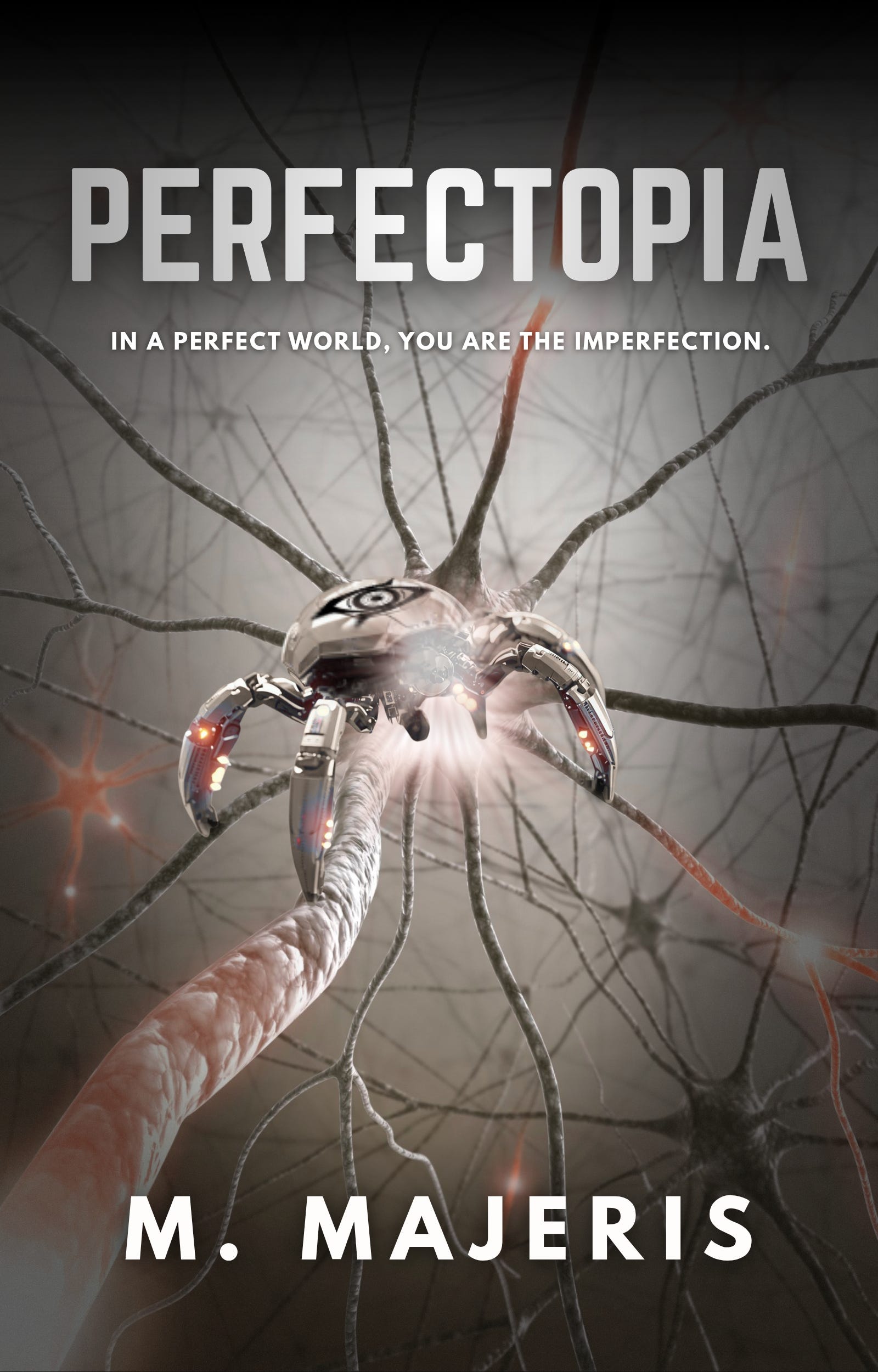
How it started
Years ago, a friend complained to me about “stupid people.” I retorted: if everyone was as smart as you, you’d be just average.
It stayed with me. In 2025 I sat down to write a serial about what such a perfectly reasonable world would look like. I was sure it would have its share of issues — but I wasn’t prepared for where the story took me.
What was supposed to be a short, comically absurd exploratory piece got disturbingly dark. It caught me off-guard and spun off into apocalyptic territory.
I like it better that way.
The story
When conformity is wired into the brainstem, the only crime left is being yourself.
A young, brilliant scientist named Sigmund has a dream — a world ruled by logic. Fairness for everyone. No suffering. No injustice. No bullshit.
That dream isn’t all he has. The technology to make it real is already within his grasp.
Sigmund and a ragtag team of his closest friends take it upon themselves to unilaterally fix the world.
First, it backfires. Then it goes completely off the rails. Before long, the group is scrambling to save what’s left of Perfectopia.
Read the opening
April 2029 | Vancouver, Canada
“Ladies and gentlemen,” Professor Martin Carmack addressed the perfectly hushed audience off the main TED podium, ”I’m proud to announce that we finally cracked the mystery of the human brain!”
A dull pain pulled at Sigmund, standing squished behind the last row of the auditorium, out of a mild trance and made him look down. Without realizing it, Gaby was squeezing his hand more than was necessary, her undivided attention on the stage. He knew she was a combination of starstruck and immersed in the grandeur of the moment. Being in a 24/7 romantic relationship with your co-worker comes with the territory of learning the tiniest quirks of one’s character. No point pulling her out for such a minor physical inconvenience. He cast his glance back to the celebrity in the spotlight.
They weren’t there for the news itself, of course—having read and re-read the papers published in the Science journal countless times, after devouring peer reviews and commentary, both of the young scientists knew exactly what was being announced. Nevertheless, they just couldn’t pass on the opportunity to see the scientific royalty’s appearance in their neck of the woods—only a short flight from Edmonton—even if the only thing the star scientist was going to do was to entertain the fancy conference crowd with the overview of a great discovery regurgitated into layman’s terms.
“Our team has identified and classified the cognitive connections between the brain’s Prefrontal Cortex responsible for logic, planning and decision making, Anterior Cingulate Cortex which monitors conflict and helps adjust behavior when something feels off, Amygdala tasked with adding an emotional weight to reasoning, and everyone’s favorite—Basal ganglia—a willing participant in habitual or reward-based decision loops and the dopamine junkie who lives in our heads.” The Professor paused, waiting for a wave of polite laughs to subside.
“In short, we can now read, with perfect certainty, the whole chain of decision-making processes in a human’s brain.” Said the Professor, pressing an invisible button, bringing up an AI-generated image of a middle-aged man salivating at a slice of a cake.
“Johnny sees a piece of cake.”
“Johnny wants to eat it.”
“Johnny knows the cake will taste good—a sample of reward dopamine already being released just at the sight of the delicious treat.”
“But…” the speaker paused for a dramatic effect… “Johnny knows the last slice belongs to Sophia.”
“There’s a whole whirlpool of complex weighting going on in Johnny’s head: guilt versus reward, possible consequences versus promise of pleasure, dietary considerations versus ingrained need for energy intake…”
“In the end, subconsciously in essence, Johnny makes a reasoned decision to leave the piece of pastry be.”
Another discreet push of a button on a remote brings up the next slide, showing a simplified flow diagram visualizing Johnny’s internal drama.
“The whole process feels superficially natural to Johnny, but we can track every step and know exactly how and why our friend has come to the ultimate decision. It is my belief that our framework opens vast new prospects for further research in practical application, including, but of course not limited to in-depth studies of human behavior, finding new cures for brain diseases, or even…” a heavy pause snuffed out a murmur, slowly building up in the auditorium… “enabling tiny modifications to our personal traits some day.”
As if struck with a jolt of concentrated energy, Sigmund froze at the last words.
Technicalities
Length: Novelette (~14,000 words / ~60 min read)
Genre: Dystopian science fiction
Format: Kindle eBook · Kindle Unlimited
Content notes: Strong language, violence, substance abuse, death, and other disturbing themes. Read at your own risk and keep away from children.
Acknowledgments
I’d like to thank Norm DePlume for sifting through initial edits for anything that would make a Canuck cringe, RM Greta (who is no longer on Substack) for spotting a few nasty bugs, Lee Stackhouse for the catchy cover art, and everyone else who read, commented, liked, restacked, shared, and generally made me feel like it’s worth publishing.
Ways, you can help (besides buying the actual book)
Add Perfectopia to your Kindle Unlimited account and actually read it. It’s free to read, and will increase the book’s rank and generate a few cents for me.
Leave a review on Amazon.
Leave a review on Goodreads.
Share to your feed on social networks (use the “Share” button below for convenience).